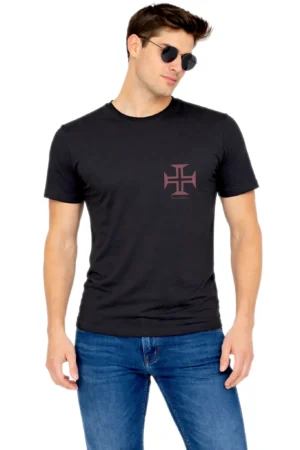


T-shirt with the Knights Templar Cross
The red cross on a white background represents the Knights Templar, a medieval Christian military order that became one of the most powerful and influential organizations of its time. Known for their bravery, secrecy, and wealth, the Templars played a crucial role in the Crusades, finance, exploration, and the shaping of modern history.
This symbol has endured through the centuries, carrying deep historical and mystical significance. Whether worn to honor their legacy, as a statement of strength and resilience, or as a nod to the mysteries and hidden treasures linked to the order, this T-shirt lets you connect with one of the most fascinating aspects of medieval history.
The Knights Templar: Warriors, Guardians, and Pioneers
 The Rise of the Order
 The Rise of the Order
The Knights Templar were founded in 1119 by a group of knights led by Hugues de Payens. Their mission was simple yet crucial: to protect Christian pilgrims traveling to the Holy Land after the First Crusade had secured Jerusalem. These knights swore vows of poverty, chastity, and obedience, becoming a religious military order sanctioned by the Catholic Church in 1129.
Unlike other knights of the time, the Templars were both monks and warriors—dedicated to their faith and skilled in battle. Their symbol, a red cross on a white tunic, became a mark of their divine mission. They established their headquarters on Temple Mount in Jerusalem, believed to be the site of Solomon’s Temple, which gave them their name: The Poor Fellow-Soldiers of Christ and of the Temple of Solomon—or simply, the Knights Templar.
The Crusades and Battles Against Islamic Forces
During the Crusades, the Templars were at the forefront of major battles against Muslim forces, defending Christian territories in the Middle East. They fought against legendary commanders such as Saladin, the Muslim leader who recaptured Jerusalem in 1187. Their elite training and discipline made them formidable opponents, and they played key roles in defending Christian strongholds like Acre and Antioch.
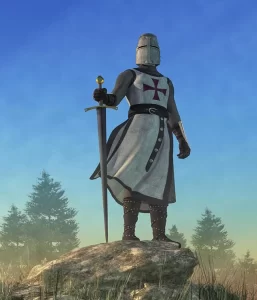
One of the most decisive battles between the Knights Templar and Saladin was the Battle of Hattin in 1187, where the Templar forces, along with other Crusader knights, suffered a devastating defeat. Saladin, the Sultan of Egypt and Syria, skillfully lured the Crusader army into the arid plains near Lake Tiberias, cutting them off from water sources and exhausting their forces under the scorching sun.
After overwhelming the Crusaders, Saladin captured the Templar Grand Master, Gérard de Ridefort, and ordered the execution of most of the Templar and Hospitaller knights, viewing them as too dangerous to be ransomed. This crushing defeat led to the fall of Jerusalem, marking the beginning of the end for Christian control in the Holy Land. Despite this setback, the Templars regrouped, fortifying strongholds such as Acre and continuing their fight against Saladin’s forces in the years that followed.
The order also faced other enemies, including the Mongols, who swept across the Middle East in the 13th century. While initially seen as potential allies against the Muslim forces, the Mongols eventually clashed with the Templars as they sought control over key territories.
However, despite their military prowess, the tides turned against the Templars as Muslim forces gradually retook the Holy Land. By 1291, the last Christian stronghold in the region, Acre, fell, marking the end of the Crusader presence in the Middle East.
The Secret Treasures and Mysteries of the Templars
One of the greatest mysteries surrounding the Knights Templar is the legend of their lost treasure. Over nearly two centuries, the order accumulated vast wealth, land, and priceless relics, some of which were rumored to include the Holy Grail, the Ark of the Covenant, and other biblical artifacts.
When the Templars lost the Holy Land, many believe they secretly shipped their treasures to hidden locations around the world. Theories suggest that their treasures were:
- Transported to Scotland, where the Templars may have aided in Robert the Bruce’s war against England.
- Taken to Portugal, where they reformed as the Order of Christ.
- Hidden in Oak Island, Nova Scotia, Canada, one of the most famous treasure mysteries in history.
- Stored in underground vaults beneath churches and cathedrals in France and Spain.
To this day, treasure hunters and historians continue searching for the lost wealth of the Templars, adding to their legendary mystique.
The First Modern Banking System
Beyond warfare, the Knights Templar revolutionized the medieval financial system. Pilgrims traveling to the Holy Land often faced the threat of robbery, carrying gold and valuables across dangerous territories. The Templars created a system where pilgrims could deposit money in Europe and withdraw it in the Holy Land using a coded document—essentially the first version of a modern banking system.
This financial network made the Templars incredibly powerful. Kings, nobles, and merchants entrusted them with managing wealth, land, and debts. However, this influence would also become their downfall.
Navigation, Trade, and Culture
The Templars were not just warriors and financiers—they were also pioneers in navigation and trade. They controlled ports, castles, and trade routes across Europe and the Middle East, accumulating knowledge about cartography, shipbuilding, and global trade. Some believe that their advanced maritime knowledge even played a role in later explorations, influencing figures like Prince Henry the Navigator of Portugal.
The Templars also helped spread architecture, science, and cultural exchanges between East and West. Their Gothic-style cathedrals and fortresses still stand today as a testament to their engineering skills.
The Fall of the Knights Templar
By the early 14th century, the Templars had grown too powerful—so powerful that they became a threat to monarchs and the Catholic Church itself. One of their biggest enemies was King Philip IV of France, who was deeply in debt to the Templars after borrowing vast sums of money. Rather than repaying his debt, Philip plotted to destroy the order.
In 1307, on Friday the 13th, the king ordered the mass arrest of the Templars across France, accusing them of heresy, devil worship, and blasphemy—charges largely fabricated to justify their downfall. Many Templars were tortured and burned at the stake, including Grand Master Jacques de Molay, who, before his execution in 1314, allegedly cursed the king and pope.
The Catholic Church officially disbanded the Knights Templar in 1312, and their assets were seized.
The Survival of the Templars: The Order of Christ in Portugal
While the order was crushed in France and much of Europe, Portugal refused to betray the Templars. King Dinis I of Portugal reorganized the surviving knights under a new name: The Order of Christ. This new order kept the Templars’ knowledge, wealth, and traditions alive, allowing them to influence Portugal’s rise as a global naval power during the Age of Discovery.
It was under the banner of the Order of Christ Cross that Portuguese explorers like Vasco da Gama and Ferdinand Magellan set sail, carrying the legacy of the Templars into a new era of exploration and expansion.
We feature also a T-shirt with the Order of Christ Cross.
Templar Cities, Castles, Strongholds, and Architectural Legacy
The Knights Templar were not only warriors and financiers but also master builders, leaving behind an architectural legacy that still stands today. Their strategic fortresses, commanderies, and cities were designed to protect Christian territories, support their military campaigns, and serve as economic and administrative hubs. Many of these sites, built with cutting-edge medieval engineering, remain as reminders of the Templars’ influence across Europe and the Middle East.
Today, the castles, churches, and cities built by the Knights Templar stand as a testament to their military, religious, and economic influence. Many of these sites have become UNESCO World Heritage locations, preserving the mystery and legacy of the Templars.
Tomar, Portugal – The Spiritual Headquarters of the Templars
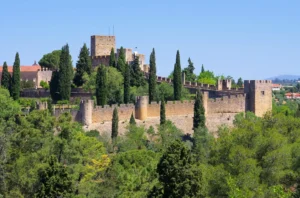 The city of Tomar in Portugal is one of the most significant Templar sites in the world. Founded in 1160, it became the headquarters of the Portuguese Templars and later the Order of Christ. The Convent of Christ, a UNESCO World Heritage Site, was originally a Templar stronghold and later expanded during the Age of Discovery.
- Convent of Christ – A stunning fortress-monastery featuring a circular Templar church (Charola) inspired by the Church of the Holy Sepulchre in Jerusalem.
- Tomar Castle – A defensive stronghold designed with advanced medieval military architecture.
Even after the dissolution of the Templars, Tomar remained a center of Templar tradition and influence through the Order of Christ, which played a crucial role in Portugal’s maritime expansion.
Acre, Israel – The Last Crusader Stronghold
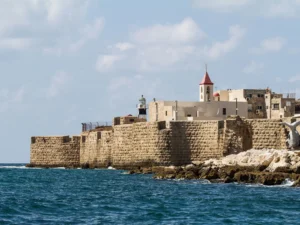 The city of Acre (Akko) in present-day Israel was one of the most important Templar strongholds in the Holy Land. The Templars fortified the city against Muslim armies, constructing massive underground tunnels and fortifications.
- Templar Fortress – Once one of the most impressive castles in the Middle East, now mostly in ruins.
- Templar Tunnels – A 350-meter-long underground passage connecting the fortress to the port, used for secret movements and supply transportation.
Acre fell in 1291, marking the end of the Crusader presence in the Holy Land.
La Couvertoirade, France – A Templar Village Frozen in Time
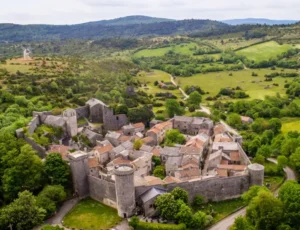
This small medieval village in southern France was established by the Templars in the 12th century. Surrounded by well-preserved fortifications, it gives visitors a glimpse into medieval Templar life.
- Templar Fortress and Walls – Built to protect the settlement and provide refuge.
- Commandery – The administrative and military headquarters of the Templars in the region.
After the fall of the Templars, La Couvertoirade was taken over by the Knights Hospitaller, but much of its original Templar architecture remains.
Major Templar Castles and Fortresses
Château de Chinon, France – The Last Templar Refuge
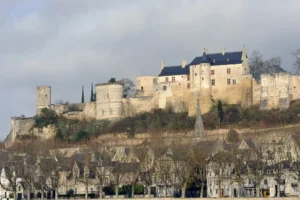 This medieval fortress was the site where the last Grand Master of the Templars, Jacques de Molay, was imprisoned before his execution in 1314. The castle played a role in the downfall of the order, as King Philip IV used it to detain and interrogate captured Templars.
- Templar Prison Cells – Still visible today, with mysterious graffiti and carvings left by imprisoned knights.
Castillo de Ponferrada, Spain – A Templar Fortress in the Iberian Peninsula
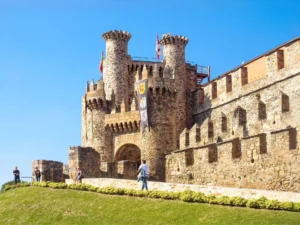 Built in the 12th century, this Spanish castle was a crucial Templar stronghold along the Camino de Santiago, the famous pilgrimage route to Santiago de Compostela.
- Strategic Location – Positioned to protect Christian pilgrims from attacks.
- Massive Defenses – Featuring high walls, towers, and a double moat, showcasing the Templars’ advanced fortification techniques.
Krak des Chevaliers, Syria – The Ultimate Crusader Castle
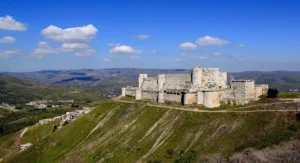 Although originally built by the Knights Hospitaller, the Knights Templar used and reinforced Krak des Chevaliers, making it one of the most impenetrable fortresses of the medieval period.
- Massive Defensive Walls – Designed to withstand long sieges.
- Strategic Location – Overlooking trade and military routes in the Middle East.
The castle fell to the Mamluks in 1271, marking the beginning of the end for the Crusader states.
Temple Church, London – The Templar Legacy in England
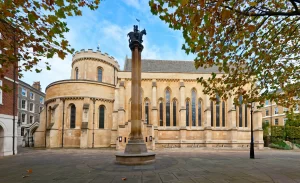 Built in 1185, the Temple Church in London served as the English headquarters of the Knights Templar. Its round design was inspired by the Church of the Holy Sepulchre in Jerusalem.
- Royal Connections – The church played a role in medieval politics and was used by the English monarchy.
- Burial Site – Several Templar knights are buried here, with their stone effigies still visible today.
After the suppression of the Templars, King Edward II took control of the church, and it later became part of the legal district known as the Inns of Court.
The Templar Influence on Architecture and Engineering
The Templars were pioneers in military and religious architecture, influencing the design of castles, fortifications, and churches throughout Europe and the Holy Land. Their architectural contributions included:
- Gothic Engineering – Many Templar churches and cathedrals were early examples of Gothic architecture, featuring high ceilings, pointed arches, and stained glass windows.
- Fortified Castles – Advanced defensive features, such as thick walls, circular towers, and secret tunnels, became standard in medieval fortification.
- Round Churches – Inspired by the Dome of the Rock and the Church of the Holy Sepulchre, the Templars often built circular churches, a rare but significant feature in medieval Europe.
Wearing the Knights Templar Symbol: A Statement of Strength and Mystery
By wearing a T-shirt with the Knights Templar symbol, you carry the legacy of these legendary builders, warriors, and explorers—a tribute to their enduring impact on history.
The T-shirt featuring the Knights Templar cross is more than just a tribute to a medieval order—it’s a symbol of resilience, mystery, and historical legacy. It represents:
- Strength and Honor – A reminder of the warriors who fought for their beliefs against all odds.
- Mystery and Hidden Knowledge – A nod to the lost treasures and secret societies linked to the Templars.
- Courage and Exploration – The Templars were not just warriors but visionaries, bankers, and navigators who changed history.
- Resistance Against Corruption – Their fall reminds us how power struggles shape history, making the symbol relevant even today.
Wearing the Knights Templar Cross T-shirt connects you with an ancient brotherhood of warriors, thinkers, and explorers, carrying their legacy into the modern world.
Read more about the Knights Templar here:
https://www.medievalwarfare.info/templars.htm
The Collection
Explore our full SymbolWear™ T-shirt collection and discover more symbols of legacy and meaning.
About the T-shirt
Information about the materials, fabrics, sizes, delivery and return policy.